
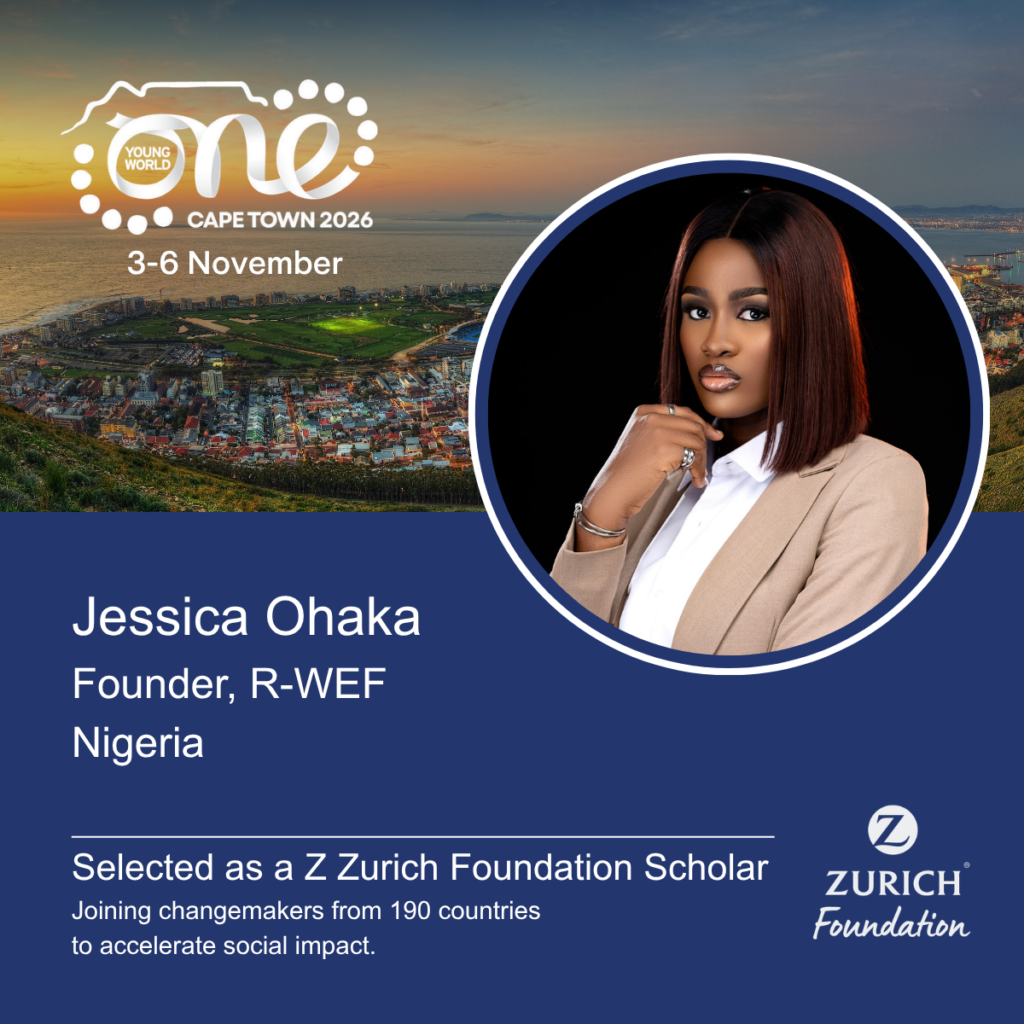
I applied to One Young World three times before I got in.
The first time, I was sure I had done enough. I hadn’t. I was rejected. The second time, same answer.
Somewhere in those three years, I also applied for the Z Zurich Foundation Scholarship. The first time, that didn’t work either.
Then this year’s Z Zurich call came out, and I read the headline twice: transitioning from learning to earning.
That was already exactly what we were doing in R-WEF’s first pilot programme, before the application was even out. I remember thinking: this one is for me.
On my second try, I got the Z Zurich Foundation Scholarship. On my third try, I got into One Young World.
What I believed then
For most of those three years, I assumed the problem was me. That I just wasn’t good enough yet. That if I worked harder and wrote better, the answer would eventually change.
If you’ve been rejected more than once, you probably know that feeling. It gets into your head. You start reading every “unfortunately” as a verdict on who you are.
It didn’t help that I already knew what it felt like to miss a line by a tiny margin. Years earlier, I missed a second-class upper by 0.08. For a lot of scholarships, that line decides whether you can even apply. So when the rejections came, it was easy to believe I was always going to fall just short.
What I know now
The truth was smaller, and much more useful.
The first times I applied, I had a description of what I’d done. A list. Nice sentences about things I cared about and things I had been part of.
By the time it worked, R-WEF existed. It was four months old. Barely anything. But it was real, I could point to it, and it was already doing the exact thing the opportunity was looking for.
Not more effort. More evidence, and a better fit.
Since then, I’ve come to believe that most rejections aren’t a sign that you’re not good enough. They’re usually one of three things going unchecked.
The three things I check before every application
01 · FIT
Are you applying to the right thing?
A strong application in the wrong stream still loses. Before you write a single word, read what the opportunity actually exists to do. Who do they fund? What do they want the people they select to go on and do?
This is what finally clicked for me with Z Zurich. The call was about learning to earning, and that was already the work. I didn’t have to stretch my story to fit. It already did.
So ask yourself honestly: does what I have actually built match what they are looking for? Not what I hope to build one day. What I have now. If the answer is no, that’s not failure. It’s information.
02 · EVIDENCE
Can you prove what you’re claiming?
Go through your application and look at every claim you make. “I am passionate about education.” “I am a leader in my community.” “I care about mental health.” Now ask: what proof sits behind each one?
Proof can be small. A project with a link. A result you can name. A document. Someone who can vouch for you. Something you started, even if it’s tiny. Four months old counted for me. Small and real beats big and described.
03 · VOICE
Are you talking to someone, or performing for a form?
For a long time I wrote applications the way I thought applications were supposed to sound. Polished. Formal. Full of words I would never say out loud.
What changed my outcomes was writing like I was speaking to a real person. Short sentences. Specific moments. What actually happened, not what sounds impressive.
ONE MOVE YOU CAN MAKE THIS WEEK
Take your last rejected application and open it up again. Highlight every claim you made. Next to each one, write down the proof: a link, a result, a name, a document.
Any claim with nothing next to it? That’s not a weakness to hide. That’s your next project.
I don’t have this all figured out. But I stopped treating rejection as a verdict and started treating it as feedback on what I could actually show.
If you’re in the middle of applying for something right now, tell me what it is. Tell me on Instagram at @jessica.c.ohaka or on LinkedIn. And if you want more of this every two weeks, join Letters from Jess below.
Build the future you want to belong to.
FOR YOUNG AFRICANS
Letters from Jess
Every two weeks: one opportunity worth your time, one lesson from my own journey, and one move you can make this week.
Free. Every two weeks. Unsubscribe any time.